Project RISE Engineering

Lead Organizations

Marysville Joint Unified School District (MJUSD) & Lindhurst High School

Total Funding Received

$130,000

Type of Funding Received

Workgroup Proposal

Who were the intended beneficiaries?

Students of Color, low-income learners, first-generation learners, and rural leaners.

A STEM program partnering with UC Davis to engage students in engineering, coding, and robotics.

About this project

Marysville Joint Unified School District (MJUSD) and Lindhurst High School (LHS) introduced Project RISE (Regional Innovation for Science and Engineering), which established an Engineering Pathway in partnership with UC Davis. The project provides students with a rigorous educational experience designed to deepen their understanding of Science, Technology, Engineering, and Math (STEM).

In partnership with UC Davis, the college pathway emphasizes hands-on projects through work-based learning experiences focused on real-world STEM careers. The local region’s strengths in agriculture, forest management, and watershed systems were integrated into the learning context.

The Engineering Pathway emphasizes coding and robotics, using the UC Davis–approved four-course curriculum in high school, as well as UC Davis–approved coding and robotics courses in elementary and middle schools.
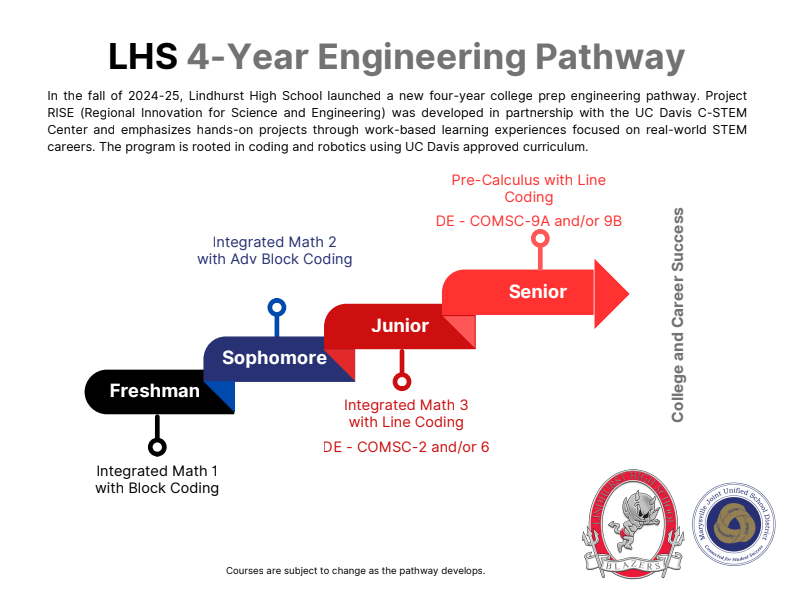
Lindhurst High School 4-Year Engineering Pathway Map

Did you run into any unexpected challenges?

The most significant challenge was implementing Project RISE as originally envisioned. During the first two years, limited school site support delayed pathway development. However, our team remained committed by maintaining partnerships and preparing for future opportunities.

A positive shift was made with new school leadership that supported the pathway vision. This allowed us to reconnect with the engineering teacher, improve the learning space, and prepare for the launch of an Integrated Math 1 course with coding in the upcoming school year.

Do you have any new insights that could help others in the Collaborative?

One of our biggest insights is that successful pathway implementation depends on more than funding and curriculum development and it also requires strong school site leadership and ongoing collaboration among partners. Administrative support plays a critical role in creating the conditions for sustainable implementation, particularly when launching new pathways that require cross-departmental coordination and long-term planning.

We also found that building on existing programs can accelerate implementation and create early momentum. Project MED benefited from an established CTE Medical Occupations course, allowing us to focus on expanding opportunities and improving equitable access rather than creating a pathway from the ground up.

Finally, we encourage partners to remain flexible and persistent when challenges arise. Our experience with Project RISE demonstrated that implementation timelines may shift due to factors outside of a project’s control, but maintaining strong relationships and continuing to prepare for future opportunities can position a project for success when conditions change. Adaptability, patience, and collaboration have been essential to sustaining progress and achieving long-term impact.